

Why Your Body Feels Slower Than It Should — Even When You’re Doing Everything Right
Many women begin to notice subtle changes in their body over time — lower energy, slower metabolism, and a feeling that their routine isn’t working the same way anymore. What if the issue isn’t effort, but internal balance?
4/5/20264 min read



There comes a moment when your body starts to feel different in a way that’s difficult to explain.
Not drastically different. Not in a way that immediately raises concern.
But enough for you to notice.
You’re still following your routine. Still trying to eat well, stay active, and take care of yourself.
Yet something feels off.
Your energy isn’t as consistent. Your body doesn’t respond the same way. And even when you stay disciplined, the results don’t seem to match your effort.
At first, it’s easy to assume it’s just part of life.
A busy schedule. A few restless nights. A temporary phase.
But when that feeling lingers, it becomes harder to ignore.
Because it’s not just about being tired.
It’s about feeling like your body is no longer working with you the way it used to.
For many women, this creates a quiet frustration.
Not something that’s openly talked about, but something deeply felt.
You try to adjust your habits. You make small changes. You stay consistent.
And still… the difference isn’t as noticeable as before.
This is where many people begin to question what might be happening internally.
Because the body is not just influenced by what we do on the outside.
It’s guided by complex internal systems that regulate how we feel, how we respond, and how efficiently everything works together.
Hormones are a big part of that equation.
They act as messengers, coordinating processes like energy production, metabolism, sleep, and even how your body stores and uses nutrients.
When they are balanced, things tend to feel more natural.
Your energy is steady. Your body responds. Your routine feels aligned.
But when that balance shifts — even slightly — the effects can begin to appear.
Not always in obvious ways.
But in subtle, persistent changes.
You may feel more fatigued than usual. Your metabolism may feel slower. Your body may hold onto weight more easily.
And even your mood and sleep can start to feel less stable.
These changes don’t necessarily mean something is “wrong.”
But they can be signals that your body is adjusting, responding, or simply asking for a different kind of support.
Modern life doesn’t always make this easier.
Stress, irregular routines, and constant stimulation can all influence how your body regulates itself internally.
And over time, this creates a kind of quiet imbalance.
Not something that stops your routine completely.
But something that changes how your body experiences it.
Understanding this shift is not about overanalyzing or trying to control everything.
It’s about becoming more aware.
Because sometimes, what feels like a lack of results is actually a reflection of how your body is functioning beneath the surface.
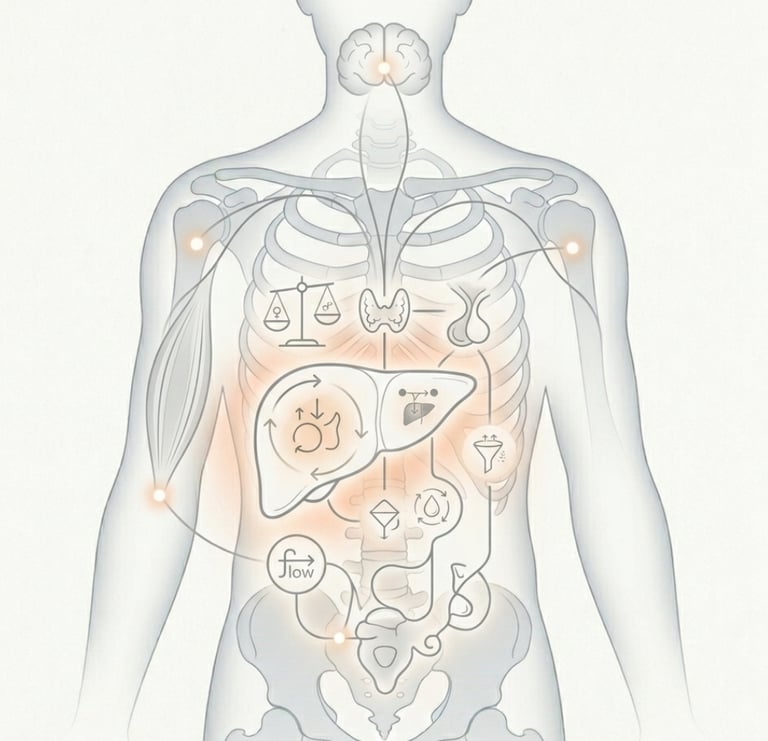
Understanding Hormonal Balance and Metabolism
Hormones and metabolism are deeply connected.
They influence how your body uses energy, how it responds to food, and how efficiently it maintains balance throughout the day.
When these systems are aligned, your body tends to function smoothly.
But when they become dysregulated, even small shifts can affect how you feel.
A slower metabolism, for example, isn’t always about age or lifestyle alone.
It can also reflect how your body is processing signals internally.
The same applies to hormonal balance.
Stress, sleep quality, and daily habits all play a role in how these systems operate.
Which is why many people are beginning to look beyond surface-level explanations.
And instead, focus on understanding how internal balance influences everything else.
What’s becoming clearer is that the body is not simply reacting to what you do — it’s responding based on how well its internal systems are working together.
And when that internal balance shifts, the effects can be felt in subtle but meaningful ways.
Energy, metabolism, and overall well-being are all connected.
Which is why taking a closer look at what’s happening internally can be an important step toward understanding how your body truly works.