

Why You Feel Tired Even After Sleeping — And How It Affects Your Body More Than You Think

Many women wake up feeling just as tired as when they went to bed. Even with a full night of sleep, energy feels low and the body doesn’t respond the same way. What if the issue isn’t how long you sleep, but how your body is actually resting?

4/6/20264 min read

There are nights when you go to bed at a reasonable time, hoping that this time will be different.
You try to disconnect from the day. You put your phone aside. You give your body the time it needs to rest.
And yet, when morning comes, the feeling isn’t what you expected.
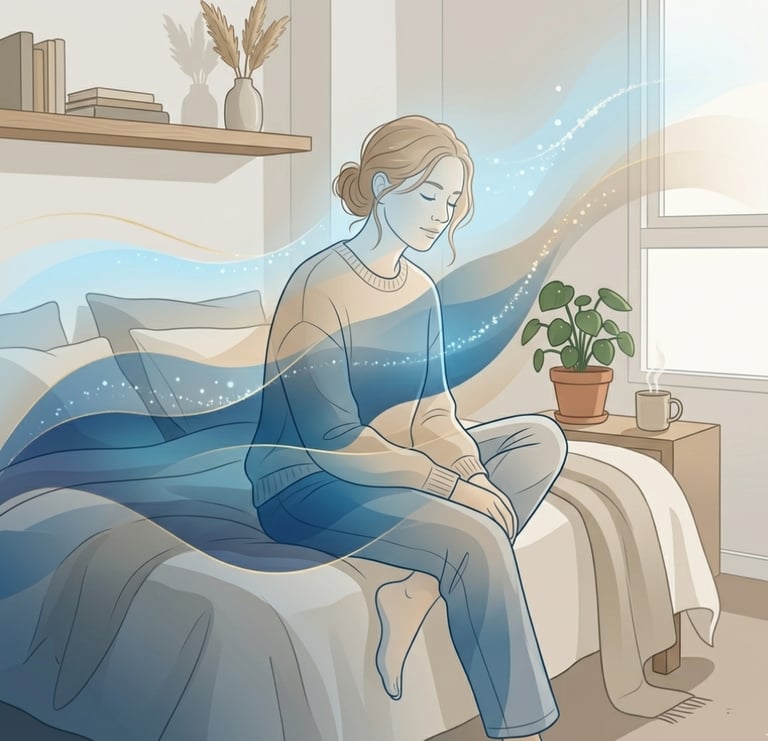
Instead of waking up refreshed, your body feels heavy. Your mind takes longer to fully wake up. And your energy doesn’t quite match the hours you spent in bed.
At first, it’s easy to brush it off.
A bad night. A stressful day. Something temporary.
But when this becomes a pattern, it starts to feel different.
Because it’s no longer just about being tired.
It’s about feeling like your body isn’t truly recovering.
For many women, this creates a quiet cycle that’s difficult to break.
You wake up already low on energy. You move through the day doing what needs to be done, but everything feels slightly heavier than it should.
By the evening, your body feels exhausted — but when it’s time to rest, your mind may still feel active, making it harder to fully relax.
And so the cycle continues.
What often goes unnoticed is that sleep is not simply about how long you stay in bed.
It’s about how deeply your body is able to rest.
Throughout the night, your body moves through different stages of sleep, each one responsible for specific types of recovery.
Some stages support mental clarity. Others regulate hormones. And some are directly involved in physical restoration and metabolic balance.
When these stages are disrupted — even subtly — your body may not complete the processes it relies on to function properly.
This means that even if you spend enough hours in bed, your body may still wake up without having fully recovered.
Over time, this begins to show in small but noticeable ways.
Your energy becomes less consistent. Your focus feels scattered. And your body may start responding differently to things like food, stress, and daily activity.
You may notice that you feel hungrier at unusual times. That your cravings increase, especially later in the day. Or that your body seems to hold onto weight more easily than before.
These changes don’t usually happen all at once.
They build gradually, often going unnoticed until they become part of your normal routine.
And because they are subtle, they are often misunderstood.
Many people assume it’s just part of getting older, or the result of a busy lifestyle.
But in many cases, it’s simply a reflection of how your body is — or isn’t — recovering during the night.
The Connection Between Sleep, Hormones, and Metabolism

Sleep plays a central role in how your body maintains balance.
During deeper stages of rest, important processes take place — including hormonal regulation and metabolic recovery.
When sleep quality is consistent, these systems tend to work more efficiently.
But when sleep is disrupted, even in subtle ways, the body can begin to respond differently.
Hormones that regulate hunger and energy may become less stable.
Metabolism may feel slower. And daily energy levels may become less predictable.
This is why more people are starting to look at sleep not just as rest, but as an essential part of how the body functions as a whole.

What’s becoming clearer is that the way your body feels during the day is closely connected to what happens while you sleep.

And not just the number of hours you spend in bed — but how effectively your body is able to enter deeper, restorative states of rest.
When that process is interrupted, even in subtle ways, the impact doesn’t stay limited to the night.
It carries into your energy levels, your metabolism, and how your body responds throughout the day.
Over time, this can create a pattern that feels difficult to explain.
You may feel like you’re doing everything right — maintaining your routine, trying to stay active, making better choices — and yet your body doesn’t seem to respond in the same way.
This is where many people begin to look a little deeper.
Not for quick fixes, but for a better understanding of what might be affecting their body behind the scenes.
Because sometimes, the issue isn’t about effort.
It’s about how well your body is able to recover, regulate, and restore itself during the night.
And when you begin to understand that connection, it opens the door to a different way of supporting your body — one that works with it, rather than against it.

Sources / References: Harvard Health Publishing. Sleep and metabolism. / Mayo Clinic. Sleep disorders and causes of fatigue. / National Institutes of Health (NIH). Sleep and circadian rhythms. / Cleveland Clinic. Why am I tired after sleeping? / American Psychological Association. Stress and sleep.

⚠️ Health & Product Disclaimer

The information provided on this page is for educational and informational purposes only and is not intended as medical advice.
While we may share insights about symptoms, supplements, and wellness products, this content should not be used as a substitute for professional medical guidance, diagnosis, or treatment.
If you are experiencing persistent symptoms or have concerns about your health, we strongly encourage you to consult a qualified healthcare professional before making any decisions.
Always speak with a healthcare provider before starting any new supplement, especially if you are pregnant, nursing, taking medication, or have an existing medical condition.
Individual needs can vary, and what works for one person may not be appropriate for another.