

Why Magnesium Matters: Benefits, Types, and How to Use It for Better Sleep and Stress Relief
Magnesium plays a key role in how your body manages stress, sleep, and daily balance. Understanding its benefits, the different types available, and how to use it can help you support your well-being in a more intentional and effective way.
3/30/20264 min read



There are moments when your body feels off, even when your routine hasn’t changed.
You might feel more tired than usual, even after resting. Your mind may feel busy at night, making it harder to fully relax. Small stressors may feel heavier, and your energy may not feel as stable throughout the day.
At first, it’s easy to assume this is just part of a busy life. Work, responsibilities, constant stimulation — all of it plays a role.
But sometimes, what you are feeling is not only emotional or situational.
It can also be physical.
Your body depends on essential nutrients to regulate how it responds to stress, how it sleeps, and how it recovers. When one of these nutrients is missing or unbalanced, the effects don’t always appear in obvious ways.
They show up quietly.
Magnesium is one of those essential elements.
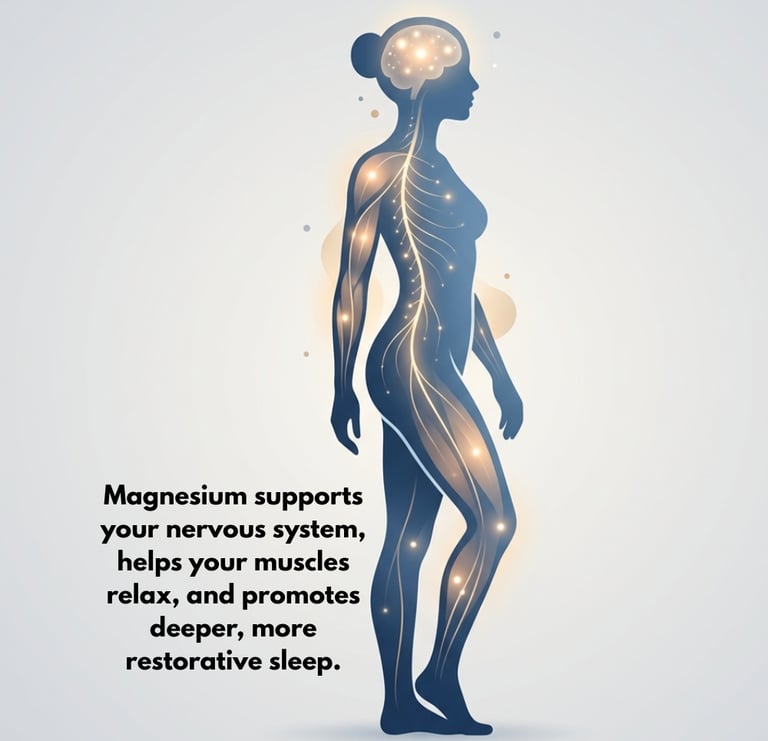
It supports hundreds of processes in the body, many of which are directly connected to how you feel on a daily basis. It plays a role in calming the nervous system, helping muscles relax, and supporting deeper, more consistent sleep.
When magnesium levels are balanced, your body is better able to slow down when it needs to. Your mind feels less restless, your muscles feel less tense, and your overall sense of calm becomes easier to access.
But when levels are low, the opposite can happen.
Sleep may feel lighter or interrupted. Your body may hold tension without a clear reason. Stress may feel more intense, even in situations that previously felt manageable.
These changes are often subtle.
They don’t stop your routine, but they change how you experience it.
Understanding this connection is the first step.
From there, it becomes important to know that magnesium is not just one single option. There are different types, and each one supports the body in a different way.
Magnesium glycinate is often associated with relaxation and is commonly used to support sleep and reduce stress. It is known for being gentle on the body and easy to tolerate.
Magnesium citrate is more commonly linked to digestion and can support regularity, making it a different kind of support depending on your needs.
Magnesium malate is often connected to energy and muscle function, which may be helpful if your fatigue feels more physical than mental.
There are also forms like magnesium threonate, which have been explored for their potential connection to cognitive support and mental clarity.
Choosing the right type is not about finding the “best” one.
It’s about understanding what your body needs most.
How you use magnesium also matters. Many people prefer taking it in the evening, especially forms associated with relaxation, as it can support the transition into rest. Others may use specific types earlier in the day depending on their goals.
Consistency is often more important than intensity.
Small, regular support tends to be more effective than occasional use.
And as with anything related to your body, awareness is key.
When you begin to pay attention to how you feel — your sleep, your stress levels, your energy — you start to understand what kind of support may be helpful.
Magnesium is not a solution on its own.
But it can be an important part of a more balanced and supportive routine.
The right type and timing can make a meaningful difference.
Not all magnesium works in the same way, and that’s where many people feel unsure. Understanding the basic differences between types can help you choose more intentionally instead of relying on general recommendations.
If your focus is relaxation and better sleep, forms like magnesium glycinate are often considered more supportive. For digestion, magnesium citrate may be more aligned. And if your body feels physically tired or tense, options like magnesium malate may offer a different kind of support.
In addition to the type, timing also plays a role. Taking magnesium in the evening is commonly associated with relaxation, while consistency over time helps your body respond more effectively.
Small adjustments, when aligned with your needs, can create noticeable improvements in how you feel.
Supporting your body starts with understanding what it needs.
When you begin to notice how your body responds to stress, rest, and daily routines, you create space to support it more intentionally.
Magnesium can be one of those small but meaningful additions that help bring more balance into your routine.
Over time, these small choices can influence how you sleep, how you feel, and how you move through your day.