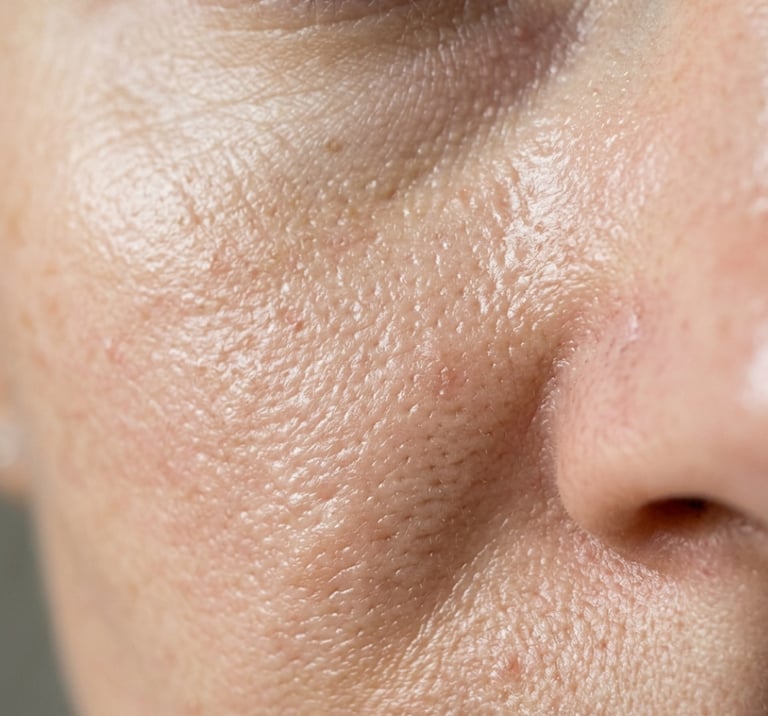
There are times when the change feels confusing rather than obvious. Your skin doesn’t just shift in one direction — it behaves in ways that seem contradictory. Instead of feeling dry, it starts to feel heavier. Areas of your face begin to look shinier than usual, and by the middle of the day, that feeling becomes harder to ignore.
At first, it might seem like a simple excess. Something surface-level. Something that just needs to be controlled or reduced. But the more attention you give to it, the less consistent it seems to become. Some days feel manageable. Others feel completely different, even when nothing in your routine has changed.
This is where the misunderstanding usually begins.
Because oiliness is often treated as an isolated issue, when in many cases it is actually a response. A form of adjustment. Your skin is not simply producing more oil without reason — it is reacting to something that is no longer fully balanced.
One of the most overlooked aspects of this process is how the skin compensates. When it perceives a lack of stability — whether in hydration, barrier function, or environmental conditions — it can begin to produce more oil as a way to protect itself. Not as a mistake, but as an attempt to restore what feels missing.
This is why the experience can feel contradictory.
When skin starts to feel consistently oily, the instinct is often to reduce, remove, or control. But balance rarely comes from extremes. It comes from stability.
Oil production is part of the skin’s natural protective system. It helps maintain flexibility, supports the barrier, and reduces excessive water loss. When functioning properly, it is not something you notice — it simply works in the background.
But when that balance shifts, the signals become more visible.
Factors such as irregular routines, environmental changes, sleep quality, and internal stress can all influence how the skin regulates itself. These influences don’t always create immediate reactions, but over time, they can alter how your skin behaves throughout the day.
Instead of focusing only on reducing oil, it can be more useful to observe patterns.
When does the oiliness increase?
How does your skin feel beneath the surface?
Does it feel balanced, or simply coated?
These questions don’t provide instant answers, but they begin to shift your attention from control to understanding.
Small adjustments can help support that process.
Maintaining consistency in your daily rhythm.
Avoiding overly aggressive cleansing routines.
Allowing your skin to stabilize instead of constantly reacting to it.
These are not quick solutions.
But they create the conditions your skin needs to regulate itself more naturally over time.
And when that happens, the changes are not forced — they are gradual, and more sustainable.
When your skin starts to feel oily in a way that doesn’t make sense, it’s rarely just about excess.
It’s often part of a larger pattern — one that began earlier, in quieter ways.
Sometimes with subtle dryness.
Sometimes with small shifts you didn’t fully notice at the time.
And as that pattern develops, the signs don’t stay isolated.
They begin to overlap.
👉 Changes in texture.
👉 Changes in balance.
👉 And eventually, changes that become visible over time.
Because when the skin struggles to stay regulated, the effects don’t always remain temporary.
👉 In the next article, we explore why your skin tone may start to look uneven — and how these small, gradual changes can lead to visible marks that feel harder to understand.
Sources / References: American Academy of Dermatology / National Institutes of Health / Mayo Clinic / Cleveland Clinic / Harvard Health Publishing / Journal of Investigative Dermatology / British Journal of Dermatology.
⚠️ Health & Product Disclaimer
The information provided on this page is for educational and informational purposes only and is not intended as medical advice.
While we may share insights about symptoms, supplements, and wellness products, this content should not be used as a substitute for professional medical guidance, diagnosis, or treatment.
If you are experiencing persistent symptoms or have concerns about your health, we strongly encourage you to consult a qualified healthcare professional before making any decisions.
Always speak with a healthcare provider before starting any new supplement, especially if you are pregnant, nursing, taking medication, or have an existing medical condition.
Individual needs can vary, and what works for one person may not be appropriate for another.
Your skin may feel oily, but not necessarily comfortable. Shiny, but not healthy. Active, but not balanced. And trying to remove that oil too aggressively can sometimes make the situation feel even more unstable over time.
Because when the skin is pushed too far in one direction, it often responds by moving in the opposite.
And that response doesn’t always happen immediately.
It builds.
Daily habits, environmental exposure, stress levels, sleep patterns, and even subtle shifts in routine can all influence how your skin behaves. Not in isolation, but together. And over time, those small influences create a pattern that becomes more noticeable.
This is why oiliness can feel unpredictable.
It’s not just about what is visible in the moment, but about what has been gradually changing beneath the surface. A slow shift in how your skin regulates itself. A quiet imbalance that becomes more visible as time goes on.
And when you begin to look at it this way, the perspective changes.
Instead of trying to eliminate oil completely, the focus shifts toward understanding why it increased in the first place. What your skin might be trying to compensate for. What changed in the background that led to this response.
Because when the cause is not addressed, the pattern tends to repeat.
Not always in the same way. Not always with the same intensity. But enough to feel like something is not fully aligned.
And that’s often the point where frustration appears.
Not because the skin is difficult, but because the explanation isn’t obvious.