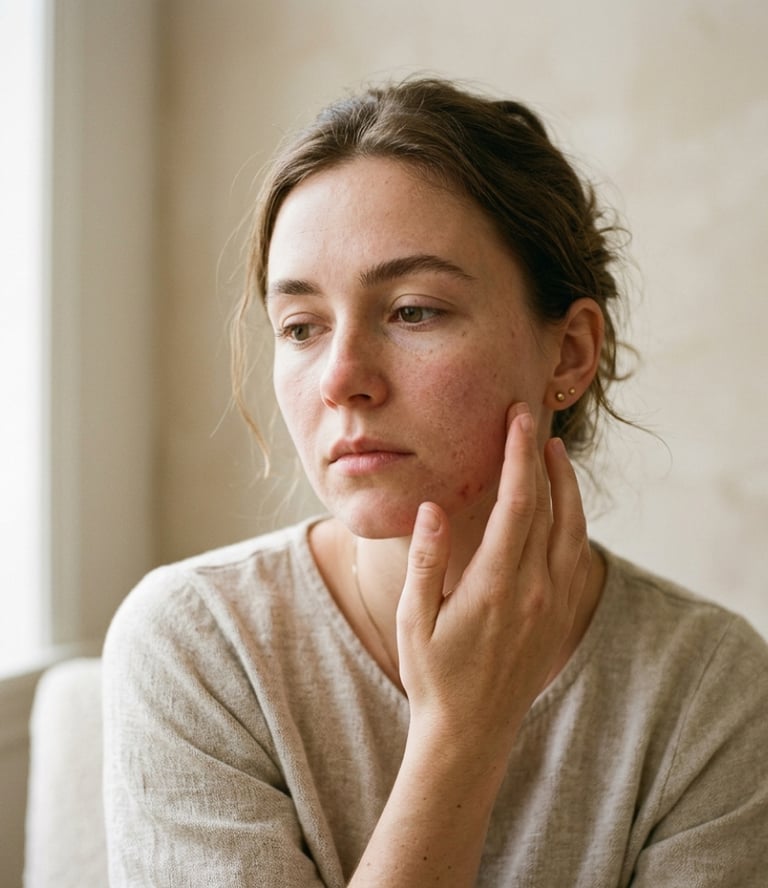
There are moments when the change is so subtle that it almost goes unnoticed.
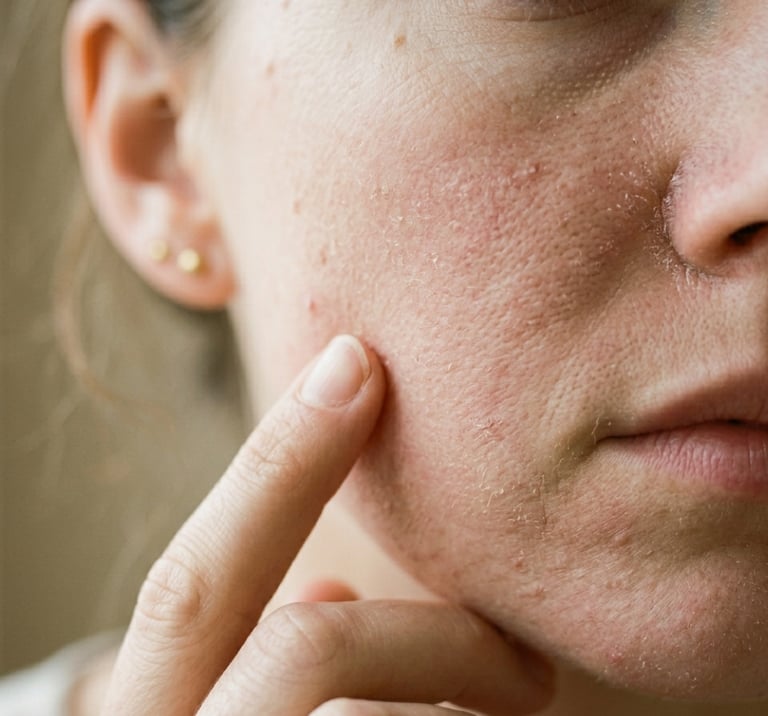
Not something that happens overnight, but something that slowly becomes part of how your skin feels each day. At first, it’s just a slight difference. A feeling that your skin is a little tighter than usual. A little less comfortable after washing. A little more aware of the environment around you.
Nothing dramatic.
Nothing that immediately calls your attention.
And because of that, it’s easy to ignore.
You tell yourself it might be the weather. Or maybe just a temporary phase. Something small that will pass on its own without needing much attention.
But as days go by, that small feeling doesn’t fully disappear.
It lingers.
And what once felt occasional starts to feel more consistent. Your skin doesn’t feel as flexible as it used to. It reacts more easily. It feels like something has shifted — even if you can’t clearly point to what changed.
This is where confusion often begins.
Because when there’s no obvious cause, it becomes harder to understand what’s actually happening.
Your routine may still be the same. You haven’t made any drastic changes. The products you use are familiar. Your habits don’t feel different enough to explain the shift.
When skin begins to feel dry, the natural instinct is to focus on the surface.
But dryness is not always just a surface condition.
It is often connected to how well your skin is maintaining its internal balance — something influenced by more than just what you apply externally.
Daily exposure to temperature changes, indoor environments, stress levels, and even the rhythm of your routine can gradually affect how your skin behaves. These factors don’t always create immediate reactions, but over time, they can shift how your skin retains moisture and responds to the world around it.
This is why the experience can feel inconsistent.
Some days feel normal. Others feel slightly uncomfortable. And the variation itself becomes part of the pattern.
In many cases, what the skin needs is not a drastic change, but a return to stability.
Small adjustments can help support this:
Paying attention to how your skin reacts after cleansing.
Avoiding overly harsh or stripping routines.
Allowing your skin time to recover instead of constantly changing approaches.
Maintaining a more consistent daily rhythm — including sleep and hydration.
These are not immediate solutions.
But they begin to support the environment your skin depends on to function well.
And when that environment becomes more stable, the skin often responds in quieter, more gradual ways.
Not instantly.
But consistently.
When your skin starts to feel different, it’s rarely random.
Even subtle changes are often part of a larger pattern — one that develops quietly over time.
And dryness is only one of the ways your body expresses that shift.
Because sometimes, when balance begins to change, the response doesn’t always move in just one direction.
👉 In some cases, the skin reacts in the opposite way.
What feels like dryness at first can slowly turn into something else — something that feels harder to understand.
A different kind of imbalance.
One that doesn’t feel dry… but doesn’t feel right either.
👉 In the next article, we explore why your skin can suddenly feel more oily — even when you haven’t changed anything in your routine.
Sources / References: American Academy of Dermatology / National Institutes of Health / Harvard Health Publishing / Cleveland Clinic / Mayo Clinic
⚠️ Health & Product Disclaimer
The information provided on this page is for educational and informational purposes only and is not intended as medical advice.
While we may share insights about symptoms, supplements, and wellness products, this content should not be used as a substitute for professional medical guidance, diagnosis, or treatment.
If you are experiencing persistent symptoms or have concerns about your health, we strongly encourage you to consult a qualified healthcare professional before making any decisions.
Always speak with a healthcare provider before starting any new supplement, especially if you are pregnant, nursing, taking medication, or have an existing medical condition.
Individual needs can vary, and what works for one person may not be appropriate for another.
And yet, your skin responds as if something is not quite aligned anymore.
What often goes unnoticed is that dryness is not always about what is happening on the surface.
In many cases, it reflects something more gradual. Something that has been building quietly in the background.
Your skin is not static.
It is constantly adjusting — to your environment, to your internal state, to the rhythm of your days. It responds to temperature changes, to air quality, to stress levels, to sleep patterns, and even to how consistent your routine is over time.
But these responses don’t always appear immediately.
They accumulate.
Small changes, repeated over time, begin to influence how your skin behaves. Not enough to create an obvious reaction at first, but enough to slowly shift how it feels.
This is why dryness can feel so difficult to explain.
Because it rarely comes from a single cause.
Instead, it is often the result of multiple small factors that, together, begin to affect your skin’s natural balance. A balance that once felt effortless, but now feels slightly out of reach.
And when that balance shifts, your skin begins to communicate in its own quiet way.
Through tightness.
Through sensitivity.
Through that subtle discomfort that doesn’t fully go away.
It’s not a sign that something is wrong.
But it is a sign that something is different.
And over time, those small differences become more noticeable.
You may find yourself adjusting without realizing it. Washing your face differently. Paying more attention to how your skin feels throughout the day. Not because you made a conscious decision — but because your body is asking for it in subtle ways.
And this is where awareness starts to matter.
Not in a way that creates urgency.
But in a way that allows you to notice patterns.
Because when you begin to notice those patterns, something shifts.
You stop seeing dryness as a random inconvenience…
and start seeing it as part of a bigger picture.
A signal that your skin is trying to adapt —
but may no longer be fully supported in the way it used to be.