

A Simple Guide to Understanding Your Skin — Beyond Dryness, Oiliness, and Dark Spots
Your skin doesn’t change randomly.
What you see is often part of a deeper pattern.

Most people try to understand their skin by looking at what appears in the moment. A feeling of dryness is treated as something isolated. Oiliness is approached as a separate condition. Changes in skin tone are often seen as a completely different concern. And because these signs don’t always appear at the same time, it becomes natural to believe they are not connected.
At first, that seems to make sense.
Each change has its own explanation, its own reaction, and often its own solution. But over time, this approach starts to feel incomplete. The skin doesn’t always return to what it once was. One issue seems to improve, but another begins to appear. And slowly, a pattern forms — not always obvious, but consistent enough to create the feeling that something deeper is happening.
What makes this more complex is that these changes rarely develop suddenly. They tend to build gradually, influenced by small factors that often go unnoticed. Daily routines, environmental exposure, stress, sleep quality, and even subtle internal shifts all play a role in how the skin behaves over time.
Because of that, what you see on the surface is often just the visible part of a longer process.
And when that process isn’t fully understood, it becomes easy to react to each new sign without ever addressing the pattern behind it.
When you begin to look at your skin as a system rather than a collection of separate issues, something starts to change. The signs that once felt disconnected begin to make more sense when viewed together.
Dryness, for example, can often be one of the earliest signals — not always severe, but enough to indicate that the skin is no longer holding balance as easily as before. In response, the skin may begin to compensate, sometimes increasing oil production in an attempt to protect itself and restore what feels missing. And over time, as these adjustments continue, the skin may start to show more visible changes, including variations in tone that reflect accumulated exposure and response.
These are not isolated events.
They are connected expressions of how your skin adapts.
This perspective doesn’t create instant solutions, but it changes the way you respond. Instead of trying to correct each sign individually, there is space to understand the sequence — how one change may have led to another, and how small, consistent factors may be influencing the whole.
And with that understanding, your approach becomes more stable.
Less reactive.
More intentional.
More aligned with how the skin actually functions over time.
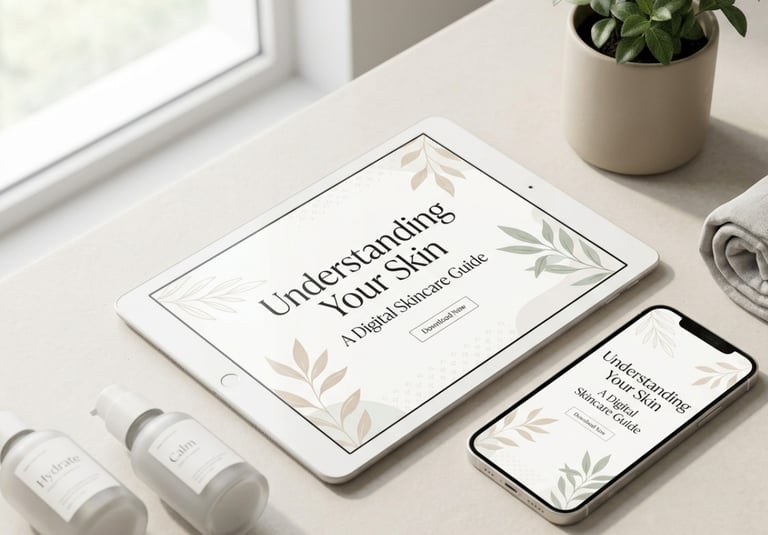

This guide was created to help you step back and see that bigger picture more clearly.
Inside, you’ll find a simple and natural way to understand how dryness, oiliness, and uneven tone can be connected — and how small, consistent adjustments can support your skin without overcomplicating the process.
Not everything needs to be immediate.
But when things start to make sense, the way forward becomes much clearer.